
荆棘鸟
23 humanoid robot teams compete in rescue missions at 2nd WHRG, facing real-world complexity beyond dancing in coordination_我的网站

一 | 王大伯今年71岁,平常和老伴儿两口子住。一天凌晨,王大伯被尿憋醒,便急忙去厕所,但怎么都尿不出来,实在憋得难受,只好在老伴儿的陪同下到了附近的医院检查,结果被查出前列腺炎。
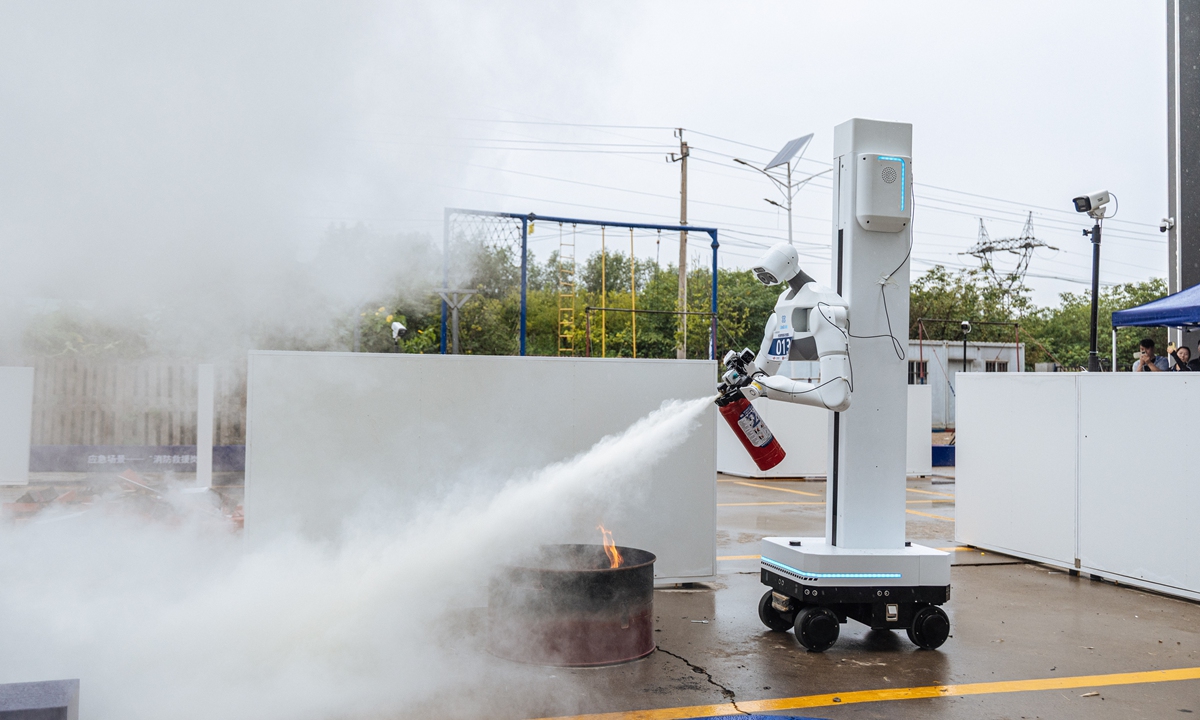
The firefighting final of the emergency management category at the 2nd World Humanoid Robot Games (WHRG) was held on Sunday in Beijing, putting 23 teams through a simulated rescue operation designed to test whether humanoid robots can move beyond demonstrations and perform practical tasks in complex real-world environments.
The event comes as Chinese humanoid robots, long known for eye-catching abilities such as running, dancing and music playing, are pushed toward practical applications, including jobs that are dangerous for humans such as emergency rescue.
Unlike the first edition of the WHRG last year, according to the organization committee, this year's scenario-based events emphasize "realistic simulation," with the firefighting competition being held at a fire brigade rather than in a model-room setup.
The competition simulated a firefighting assignment that required each of the 23 robots to complete three tasks within 30 minutes: identify hazardous materials, shut off valves and operate a fire extinguisher. For the first task, robots had to identify two randomly placed simulated hazardous substances and report their types to judges through returned images. They then had to locate three randomly selected open valves of different types and shut them off before identifying a fire source, finding a fire extinguisher and spraying it until the fire was put out.
Human firefighters were also involved in the event, lighting the fire and observing whether the robots carried out the extinguisher operation correctly.
The competition, however, showed how difficult it remains for robots to perform reliably outside controlled laboratory conditions.
Rain affected the competition, while changes in lighting and the outdoor environments added uncertainty to the robots' visual recognition and manipulation tasks. A team from UniX AI, a company well-known for its robot applications on real-world scenarios and has just raised a new round of 300 million yuan ($ 44.49 million) in late March, completed its run within the allotted time, but its robot moved relatively slowly compared to human firefighters' real practice. When operating the fire extinguisher, its robotic hand had to make two attempts to align with the target.
Of 12 teams competed on Sunday, three finished the challenge.
Yang Liqi, a representative of the UniX AI team, told the Global Times that the firefighting scenario placed higher demands on both the robot's recognition and manipulation capabilities.
"Rain and lighting conditions can affect the robot, and actual situations are often different from what we simulate in the laboratory," Yang said, noting that this was also one reason why a number of teams were unable to complete their runs on Sunday morning.
The team had programmed the robot to make up to three attempts when operating the extinguisher. "If it sees white smoke after the first attempt, it will not make a second attempt," Yang said.
The difficulty was not simply that whether the robot could move its arm. Humanoid robots rely on different types of joints for different tasks: small, high-precision joints enable delicate hand operations, while high-torque, reliable joints support movement and balance.
A failure at any point of actions and detection could affect the final result. This is precisely where the value of real-world competitions lies, Jin Chenran, a representative of the Tiangong team whose robot only accomplished one of the three tasks, told the Global Times.
"Whether the competition goes smoothly or not, that is the significance of a real-world simulation. Every real-world failure is valuable data that helps humanoid robots toward practical application," Jin said.
Jin further explained that questions like why the robot failed to recognize an object and how its motion-planning system selected the wrong path... Such data can subsequently be used to improve algorithms and train AI models.
The competition also offered a glimpse into the current transitional stage of humanoid robot technology. At the venue, some team members were wearing VR headsets and remotely adjusting their robots shortly before their runs.
Some humanoid robots were seen using omnidirectional wheels instead of feet, while their hands featured multiple joints to enable more precise manipulation. Many teams chose China-developed UBTECH's joint modules for their robots. Its servo actuators cover a wide torque range from 0.2Nm to 200Nm, allowing robots to combine dexterity with strength. Meanwhile, VR teleoperation gives operators a first-person view through the robot's cameras, enabling them to remotely guide movements in real time.
The event comes amid a broader push in China to move humanoid robots and embodied intelligence from laboratories and competition arenas into real production and daily-life environments. In June, the Ministry of Industry and Information Technology and the other departments launched a special program for humanoid robots and embodied intelligence that encouraged applications in practical fields including emergency rescue.
Zhao Weidong, deputy director of the organizing committee office, told the Global Times that the scenario-based competitions are intended to test the progress of humanoid robots from "competition performance" toward "real operational work," including whether they can eventually become intelligent partners for firefighters.
"At present, many simulations of actual operations may still be at an early stage," Zhao said. "But these are an important starting point for enabling robots to truly assist humans in real-world environments, as well as an important source of data and testing."
The ultimate goal, Zhao said, is to push robots into fields where human operations are dangerous and achieve genuine "human-robot complementarity."
。问诊后医生了解到王大伯不爱运动,平常吃完饭就喜欢躺着,要不就是坐着玩一下午扑克和麻将。

二 | 而这些久坐不动的习惯,加速了前列炎的发生。上了年纪的男性,很容易被前列腺疾病盯上,一定要提高警惕!一、前列腺炎:50岁以下男性易遭遇天津中医药大学第一附属医院男科主任耿强介绍:前列腺是男性的生命腺,每个年龄段的男性都可能被前列腺疾病盯上,而且据统计半数以上的男性60岁后会被前列腺增生盯上,80岁后男性前列腺增生高达83%。四川大学华西医院泌尿外科主任医师董强介绍:前列腺炎在50岁以下的男性中更为常见,饮食、泌尿生殖道炎症、职业、精神心理因素、季节、性活动、良性前列腺增生等是前列腺炎发生的高危因素。

三 | 前列腺炎有急性和慢性之分,急性前列腺炎相对少见,但可能会危及生命;慢性前列腺炎比较常见,虽然不会危及生命,但也要注意及时就诊治疗。

四 | 急性前列腺炎可能会有全身症状、局部症状、尿路症状和直肠刺激症状,出现高热、寒战、乏力、厌食、呕吐、肌肉酸痛、会阴区或耻骨上不适、尿急、尿痛、排尿不畅、大便急、排便疼痛等症状。

五 | 慢性前列腺炎可能会有夜尿增多、尿急、尿痛、尿频、下腹部隐痛、焦虑、抑郁、乏力、头晕、早泄、勃起功能减退等症状。

六 | 无论是急性还是慢性,都要及时就诊排查治疗。二、9个不良习惯很伤前列腺,尽快改某些不健康的行为习惯会危害人体的健康,华中科技大学同济医学院附属同济医院主任医师王志华、王少刚提醒:下面这几个习惯不利于前列腺健康,一定要趁早改掉!1、经常憋尿:经常憋尿会导致膀胱充盈胀大,引发排尿无力,从而加重前列腺增生症状。2、性事不当:短期内性生活过于频繁,很容易引发急性前列腺炎,另外像体外蛇精、性生活中断等也可能会引发炎症。

七 | 3、肥胖:体重过于超标,也会危害前列腺健康,增加前列腺疾病风险。4、吸烟:长期吸烟的人患前列腺疾病的风险更高,而且吸烟量越大,前列腺健康受损程度越高。5、受凉:受凉会导致交感神经兴奋,引起前列腺腺体收缩,影响排尿,进一步引发前列腺病变。6、挤压:经常久坐不动、骑行,会导致前列腺总是受到挤压,影响血液循环,甚至刺激并引发前列腺疾病。

八 | 7、便秘:便秘、肠道内粪便过多会加重前列腺充血,压迫前列腺,甚至影响前列腺健康。8、感染:感染可能会加重前列腺疾病,引发排尿困难。

九 | 9、饮食不节:饮食上偏好酸性食物、辛辣刺激的食物或者长期饮用烈酒,都可能会导致血管扩张,前列腺充血,甚至诱发前列腺炎。三、做好6个一点,护好男性“生命腺”华中科技大学同济医院 泌尿外科王少刚主任医师、胡志全主任医师及王志华主任医师表示:想要保护好男性前列腺,平常要做到下面这几点!多喝一点温水:多喝温水能促进尿液排出,多冲洗尿道,避免尿液的浓缩,以免危害到前列腺健康,预防前列腺感染。饮食健康一点:饮食上要保证食物的多样化,多吃苹果、坚果等含抗氧化剂、锌等物质的食物,以更好的维护前列腺健康。少久坐一点:长期久坐不动会反复刺激前列腺,甚至诱发前列腺炎、前列腺增生,因此要避免长期久坐不动。天冷多穿一点:前列腺也怕冷,因此天气寒冷的时候要多穿点,以免引发前列腺炎或其他前列腺疾病。跑厕所勤一点:经常憋尿会压迫前列腺,甚至引发尿潴留、排尿困难等症状,因此有尿记得去排出来。

十 | 少吃一点辛辣:辛辣刺激的食物会刺激前列腺和尿道,导致前列腺充血,不利于前列腺健康。男性很容易被前列腺疾病盯上,平常一定要关注前列腺健康,尽早改掉一些不健康的习惯。如果出现疑似前列腺炎的症状,要及时就诊排查。参考资料:[1]《六个一点,护好男性“生命腺”》.华中科技大学同济医院.2022年04月22日[2]《9个不良习惯会伤害前列腺健康》.人卫健康.2023年11月22日[3]《年轻前列腺炎→中年前列腺增生→老年前列腺癌?华西专家说男人哪有那么造孽!》.健康时报.2021年07月13日未经作者允许授权,禁止转载。
Current article:http://w1a407.rangzhuanhoujuedu.cyou/9fogag/20260826/894781.html
Published on:07:43:42
栏目相关
- 杭州煊荣科技有限公司乱扣费,自动续费
- “他们没告诉我啊!”浙江男子新房刚要装修,一看傻眼了!
- 【观点】申银万国:铝锭社会库存持续去库,铝价上方承压
- 23 humanoid robot teams compete in rescue missions at 2nd WHRG, facing real-world complexity beyond dancing in coordination
- 乐山大佛景区回应“安保人员踩死松鼠”
- 近郊短途自驾出游,山水营地,露营烧烤轻松安排妥当轻松惬意
- 国家防总对浙江福建启动防汛防台风三级应急响应
- 艺人贺国庆 钟琴跑59公里陈泰铭潮州饶舌
- 《环球时报》答读者问:什么是暴利税?
- 【成长·传承】今日冬至
- 퇴직연금 ‘AI 투자’에 꽂힌 5060
- 方寸之间 彰显城市文博底蕴
热门排行
- 江西女贪官刘武爱落马,六毒俱全,主动投案,照片曝光,富贵逼人
- 台风登陆前后,杭州风雨交加 白堤上被风吹坏的雨伞装满了一车
- 媒体人谈09国少vs墨西哥冲突:也要多感受不同风格的足球
- 诚毅幼儿园2025年寒假致家长一封信
- 河南省成功发行政府债券300.81亿元
- 8月25日集合竞价:深中华A4连板 海鸥住工2连板
- Qwen登顶AI赚钱大赛只是开始?“弃GPT投Qwen”已在硅谷蔓延开来
- 上海通报闵行区一单位发生火灾:火势已扑灭,无人员伤亡
- 克莱满怀争冠期待赴独行侠 却遭遇球队巨大动荡
- 山西奔驰女司机碾压孩子后续:遭奔驰女司机碾压男童被下病危通知
- China FA launches probe into alleged KFA 'inappropriate hospitality'
- Microsoft Surface Laptop 1/2推出Windows 10固件更新:海量内容